
Quantum Materials & Imaging Laboratory
Ibrahim Abdelwahab, Staff Scientist

Our Research
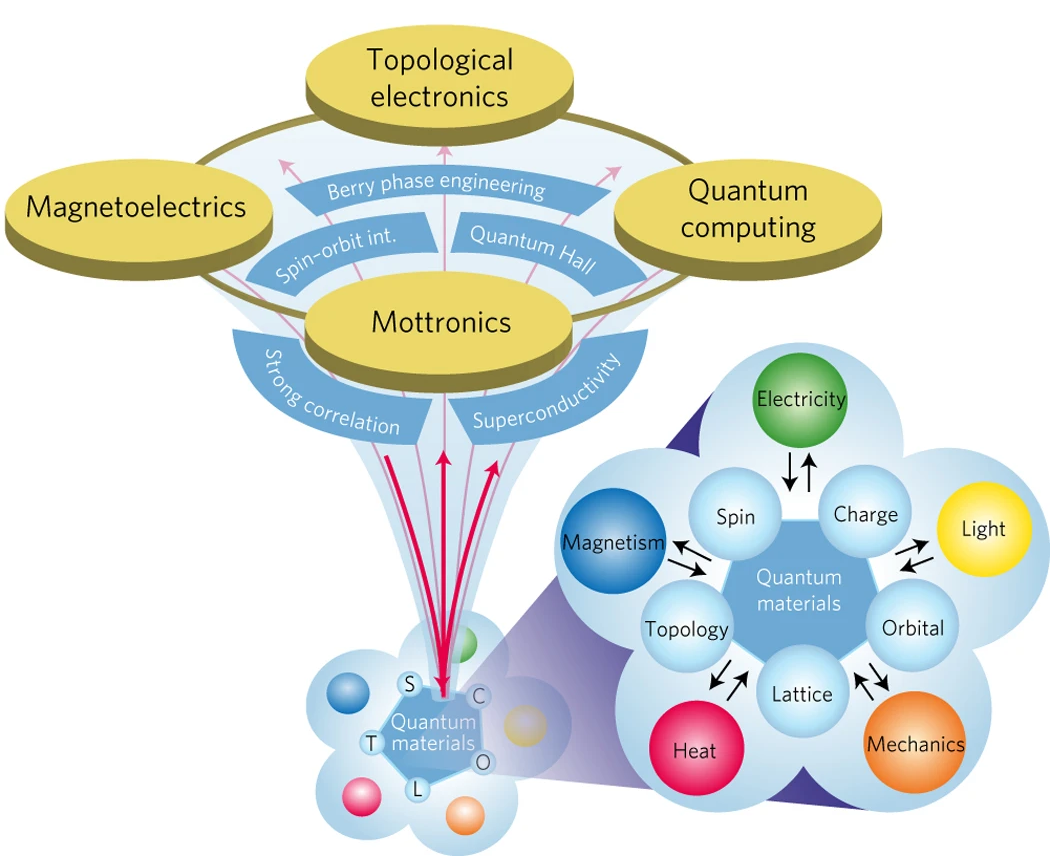
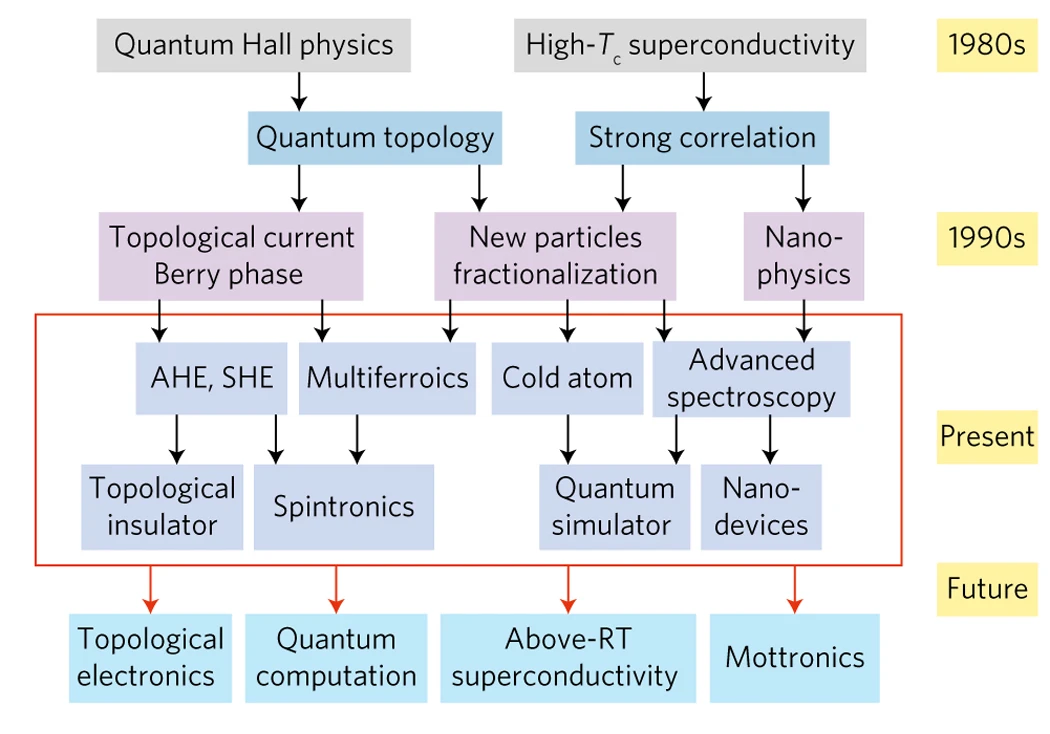
Electrons in quantum materials possess multiple degrees of freedom—charge, spin, and orbital—all shaped by the topological and chiral properties dictated by the crystal lattice’s atomic potential. The complex interplay between these degrees of freedom gives rise to a diverse array of electronic phases, especially in the two-dimensional (2D) limit. Our interdisciplinary research investigates and seeks to control the dynamics and coupling of these quantum degrees of freedom, with the goal of harnessing these emergent phases for next-generation applications.
Research Themes
Cryogenic Nanoscopy
Visualizing the Invisible: Nanoscale Insights into Quantum Materials
Representative Publications:
Nature Communications 13, 138 (2022)
Science Advances 8, eabj0395 (2022)
Nature Communications 11, 5483 (2020)
Advanced Materials 30, 1704619 (2018)

Van der Waals materials & devices
Building Tomorrow’s Devices, One Layer at a Time
Representative Publications:
Nature Materials 17, 908 (2018)
Nature Chemistry 9, 563 (2017)
Nature Communications 13, 1884 (2022)
JACS 139, 2504 (2017)

Sustainable AI & Quantum Hardware
Advancing Neuromorphic & Photonic Quantum Computing with Energy-Efficient Devices
Representative Publications:
Science 385, 311 (2024)
Nature Photonics 16, 644 (2022)
Adv. Funct. Mater. 30, 2004609 (2020)
Advanced Materials 31, 1902685 (2019)

We specialize in advanced scanning probe microscopy techniques.
We specialize in cryogenic nanoscopy, using advanced scanning probe techniques such as cryogenic s‑SNOM and PiFM to probe the optical and electronic properties of low-dimensional quantum materials at sub‑10 nm resolution (from the visible to the terahertz) and at temperatures below 10 K. By identifying and engineering next-generation quantum materials, our research drives the development of energy-efficient devices critical for sustainable AI, quantum hardware, and future energy technologies.

Research Facilities
At Harvard, we established the university’s first cryogenic scattering-type scanning near-field optical microscope (s-SNOM) to investigate novel phenomena in low-dimensional quantum materials. This platform uniquely integrates state-of-the-art s-SNOM technology with cryogenic capabilities, broadband laser sources, and in situ electric fields—making it one of fewer than 20 such systems worldwide. It enables comprehensive analysis of quantum materials across multiple length, frequency, and energy scales, which is crucial for probing quasiparticle reconstruction, topology, and correlated-electron excitations.

Representative Publications


44
Publications
32
h-index
>4,900
Citations
Top 1%
Most highly cited authors in materials science over the past 10 years
Publications
>40 Peer-Reviewed Journal Publications in top‐tier scientific journals, including Science, Nature Photonics, Nature Materials, Nature Chemistry, Nature Communications, Science Advances, Advanced Materials, JACS, ACS Nano, Nano Letters, etc.